Faculty Learning Communities
Collaborative for Academic Growth
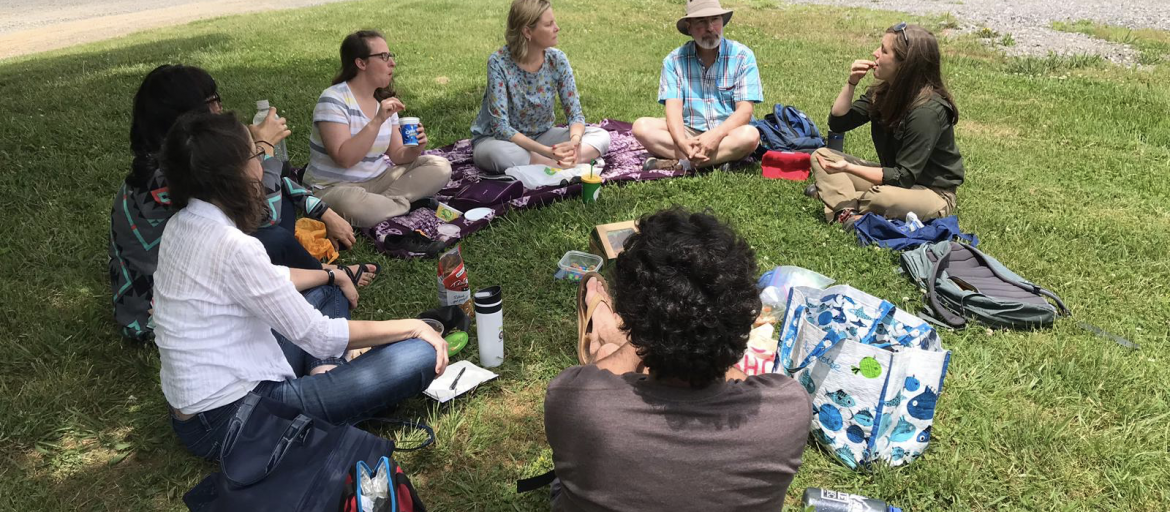
Faculty learning communities (FLCs) provide an opportunity for a multidisciplinary group of 6-12 faculty to work together over an extended period of time on a project of mutual interest. As with our campus learning circle model, FLCs bring together faculty from across the university, assume no prior expertise of members, and ideally, offer a supportive and collaborative environment for active learning and inquiry. Unlike learning circles, UNCA FLCs last a full academic year and culminate in a goal-oriented final report.
One working group took place in 2020-2021, three FLCs took place in 2019-2020, four FLCs took place in 2018-2019, with links to their final reports provided below. FLCs have been on hiatus the past few years, but we look forward to bringing back new opportunities starting this Spring 2025.
2025-2026
- AI Departmental Liaisons: Curating Discipline Specific GenAI Resources Faculty Learning Community (CDSAI – FLC) (Stephanie O’Brien, facilitator) — click here for more information, interest form due March 31, 2025!
- Developing Discipline-Specific Strategies for Supporting Student Writers (Brian Graves & Robert Bell, facilitators)
2020-2021
- Black Humanity Matters (Agya Boakye-Boaten & Jeremias Zunguze, facilitators), a working group to develop critical capacities in centering Black epistemologies
2019-2020
- Analyzing and publishing scholarship of teaching and learning (SoTL) projects (Jen Rhode Ward & Greg Boudreaux, facilitators), a study of cross-disciplinary best practices in SoTL, culminating in submission of a SoTL abstract, presentation, or publication at a professional conference
- Centering de-colonial approaches in the liberal arts classroom (Trey Adcock, Ameena Batada, & Jeremias Zunguze, facilitators), an analysis of practices of colonialism in higher education, the development of a rationale for decolonizing teaching-learning methodology, and an exploration of relevant decolonial concepts
- Faith in arts (Eva Bares & Rick Chess, facilitators), a deep engagement with varied works of art informed by, or created for use in, religious or spiritual contexts
2018-2019
- Teaching ethics without formal ethics (Melissa Burchard & Elizabeth Harvey, facilitators), an examination of methodologies and pedagogies for teaching ethics across the disciplines, using methods that do not rely on formal ethical theories
- Support for sustainability tools and learning (Alison Ormsby & Sonia Marcus, facilitators), an exploration of environmental sustainability topics and strategies for their incorporation into new or existing coursework at UNCA
- UNC Asheville prison education program (Regine Criser & Patrick Bahls, facilitators), an investigation of best practices for providing higher education programming in prison, and initiation of the UNCA program at Avery-Mitchell Correctional
- Intersectional feminist pedagogies (Lyndi Hewitt & Lise Kloeppel, facilitators), a study of pedagogical strategies for addressing diverse identities and structural inequalities, with an emphasis on gender and sexuality
New Faculty Programs
New Faculty Resource Guide is a comprehensive list of resources about teaching at UNC-Asheville.
New Faculty Orientation is an opportunity for first-year faculty to become acquainted with UNC Asheville resources and personnel, and to learn about unique aspects of our campus culture. This one-day program takes place during the week before the start of the fall semester.
The New Faculty Mentoring program welcomes new colleagues to UNC Asheville more informally, matching new faculty members with experienced faculty who serve as individual mentors. As noted in the faculty handbook, new faculty success depends not only on expanding academic knowledge and skill sets, but also on the “ability to develop connections and relationships with colleagues.” A volunteer program for both mentors and mentees, it provides new faculty the opportunity to meet potential mentors and participate in their selection. In addition to one-on-one, confidential mentoring meetings, mentees and mentors are invited to social gatherings throughout the year.
New Faculty Lunches and other ongoing programming provide continued orientation opportunities for new faculty as well as the chance to connect with other first-year colleagues. Intended to complement the experiences of participants in the New Faculty Mentoring program, lunches (provided by the CTL!) offer a chance for one-on-one check-in and consultation, while other gatherings provide time for reflection and discussion about issues of special importance to early-career professors.