Budget Office
Role of the Budget Office
Mission: The University Budget Office supports the University through financial analysis, budget development, and budget execution. We strive to manage University resources proactively and in alignment with the University’s strategic goals.
The Budget Office works closely with University departments as well as the UNC System Office and North Carolina Office of State Budget & Management to develop, execute, and report on the University’s budget.
Through Budget Development, the Budget Office plans for the use of University resources in the next fiscal year. This work is done collaboratively with each University department.
Through Budget Execution, the Budget Office establishes the approved budget in Banner and monitors spending relative to authorized amounts.
The Budget Office within the Budget & Finance division is the principal arm of the university in the area of financial planning and fiscal administration. The department delivers, executes and monitors a sound fiscal plan in compliance with statutory, legislative requirements and administrative directive. It has primary responsibility for development, distribution and maintenance of biennial, annual operating, continuation, expansion, capital, auxiliary, receipt and other institutional or departmental budgets as well as being a significant contributor for forecasts and development of the institutional financial plan.
The UNC Board of Governors (BOG) develops and prepares for the Governor and the General Assembly a single, unified recommended budget for all of the UNC constituent institutions. That process is guided by the UNC System Office. As a member of the UNC System, UNC Asheville’s budget is approved by the UNC Board of Governors. During development, the UNC System Office issues guidelines for compilation and guides budget priorities for current operations, expansion or improvements. After legislative debate, the NC General Assembly appropriates the state academic budget. Following legislative action, the Board of Governors and the System Office allocate funds, including increases and reductions, to each member school. State appropriations are received through an allotment and requisition system via the NC Office of State Budget and Management and the NC Office of State Controller.
UNC Asheville follows state regulation in formulating all general operating, renovation, repair, capital or other fund budget. In preparation for each biennial budget, the Office of State Budget and Management (OSBM) holds meetings with state agencies to review agency-specific program inventories and to discuss how information is to be collected for the budget development process. OSBM issues instructions for the preparation and oversees submission of budgets as required by the General Assembly on a biennium or annual basis.
The UNC Asheville Budget Office provides basic information and guidance to all departments/schools and offices regarding the establishment, revision, reporting, administration and control of budgets as directed by the Chancellor, Board of Governors, State Budget Office, and North Carolina General Statutes. The state budget process incorporates a high level of control and directs much of the budget. Non-state budgets are funded from various sources which include fees, auxiliary receipts, grant awards, gifts and endowments. Budgets are formulated based on prior receipts and expenditures with adjustment for coming needs. Capital Projects are funded through state funding, grants, bond issues, or other private funding.
Budget Cycle Calendar
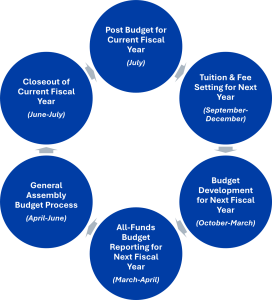
Each fiscal year happens more or less on the same schedule, with execution of the current year budget and development of the next year’s budget happening concurrently.
The budget cycle below illustrates some of the major events each year in the budget cycle.
Budget Data
The University Budget Office, consistent with the State Budget Act, state and federal legislation, and other rules and policies, maintains updated budgets for fiscal management and reporting purposes.
All Funds Budget
The All-Funds Budget, completed in April of each year, provides revenue and expenditure estimates for the General Fund, Trust Fund and Auxiliaries, Overhead Receipts, and Restricted Trust Funds.
The General Fund Base Budget is defined in General Statute 143C-1-1(d)(1c). Every two years, the base budget is updated in coordination with the Office of State Budget and Management and serves as the baseline for the next fiscal year. All budget adjustments in the biennial budget are made to the Base Budget.
Budget Development
The role and function of the University Budget Office in budget development is to meet with University departments to help review and better understand budgetary needs. Through this process, the University Budget Office will help develop and review budget requests for the next fiscal year, ensuring that requests are aligned with the strategic goals of the University. The most recent budget development instructions are found below.
Budget Execution
The role and function of the University Budget Office in budget execution is to load the approved budget and to administer the budget to ensure that state appropriations and other funds are expended for the purposes for which they were authorized. This is accomplished through interpretation of state and federal legislation, rules, and policies and other governing budget language.
The University Budget Office provides technical assistance and guidance to University departments in carrying out their delegated responsibilities related to budget execution, including the evaluation of budget adjustment requests to ensure compliance with the State Budget Act, state and federal legislation, and other rules and policies.
Below is a link to the budget revision form used for submitting budget revision requests to the University Budget Office. For more information about the revision process and the difference between department-level revisions and those requiring University Budget Office approval, please see the following training material.
Resources
Find training presentations, videos, and job aids here. These resources are meant to provide information about budget concepts and processes to university business officers and fund managers.
Budget Staff

James Robinson
University Budget Director
Office: 214B Phillips Hall
Phone: 828-232-2268
Email: jrobins7@unca.edu
Erika Covey
Senior Budget Analyst
Office: 214D Phillips Hall
Phone: 828-251-6505
Email: ecovey@unca.edu

Megan Covey
Senior Grants & Contracts Accountant
Office: 214D Phillips Hall, CPO 1422
Phone: 828-251-6581
Email: mcovey@unca.edu