Art and Life in Pompeii
Course Description
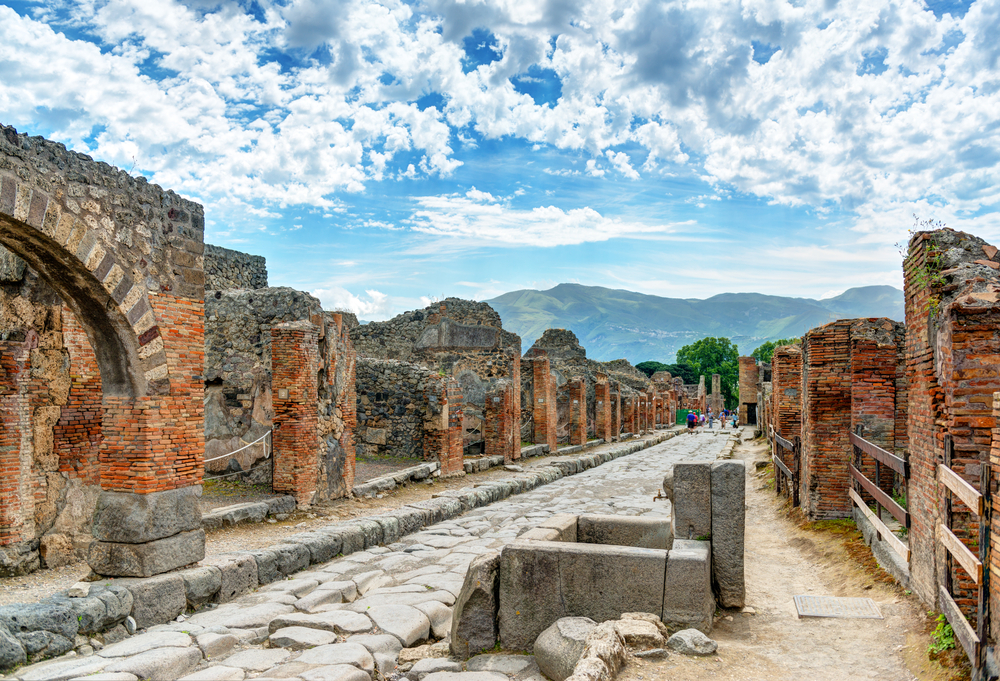
We live in a world shaped by civilizations we rarely pause to examine up close, yet few archaeological sites offer as intimate and vivid a window into ancient life as the city of Pompeii. Simultaneously destroyed and preserved by the eruption of Mt. Vesuvius in 79 CE, this once-ordinary Roman town on the Bay of Naples became one of the most extraordinary and important archaeological sites in the world, capturing everything from monumental public architecture to the mundane details of daily existence, and inviting us to consider what the ancient past can reveal about the human experience.
This first-year seminar examines the physical world of Pompeii through a largely archaeological lens, exploring public art, architecture, and infrastructure alongside the more private spaces of houses, gardens, shops, taverns, and cemeteries. Drawing on both material culture and ancient texts, students will engage with a multicultural and diverse ancient city, interrogating the stories its ruins preserve and the methods we use to uncover them.
Faculty Spotlight
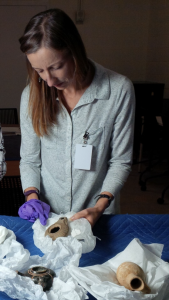
Laurel Taylor, Ph.D. – Assistant Professor, Art History
Academic background
Dr. Laurel Taylor teaches in the Department of Art and Art History. She teaches a wide variety of courses on material culture, art history and archaeology. Her research interests include funerary ritual and commemoration and rural archaeology. Dr. Taylor’s current archaeological fieldwork is at the Etruscan and Roman site of Cetamura del Chianti, Italy. She has also directed excavations at the UNC Asheville field school at Palazzaccio, a Roman period farmhouse located outside of Lucca, Italy, and part of the UNESCO ‘Project of 100 Roman Farms’. Previously Dr. Taylor worked with the University of Pennsylvania and Cornell’s excavations at a palace of Herod the Great in Caesarea Maritima, Israel. Dr. Taylor is president of the Western North Carolina chapter of the Archaeological Institute of America. Her publications include a wide range of topics, from gender studies to craft in the ancient world to funerary ritual and monuments. She served as the co-chair for the Etruscan Interest Group (2019-2021) for the Archaeological Institute of America and the Editor in Chief for the Journal of Etruscan and Italic Studies (2022-2025).
She holds a PhD in Mediterranean Archaeology from the University of Pennsylvania, an MA in Classical Archaeology from Florida State University, and a BA in International Studies from the University of North Carolina at Chapel Hill.
What makes this course meaningful for students?
Dr. Taylor love teaching this course because it allows students to immerse themselves in an ancient city like no other. Because so much has been preserved at Pompeii, studying the city allows for a rich, immersive experience in which students can understand the daily life of an average citizen– what they saw, what they ate, what they did for entertainment– and how similar (yet also how different) their lives were from ours. This is also an experiential learning course that gives students the opportunity to learn by making as we work with different Roman art forms (mosaics, ceramics etc).
Favorite spot in Asheville
Dr. Taylor’s current favorite restaurant is Saffron and she is a big fan of Asheville Community Square Dance.