Professor Awarded UNC Asheville’s First-Ever Grant from the National Cancer Institute
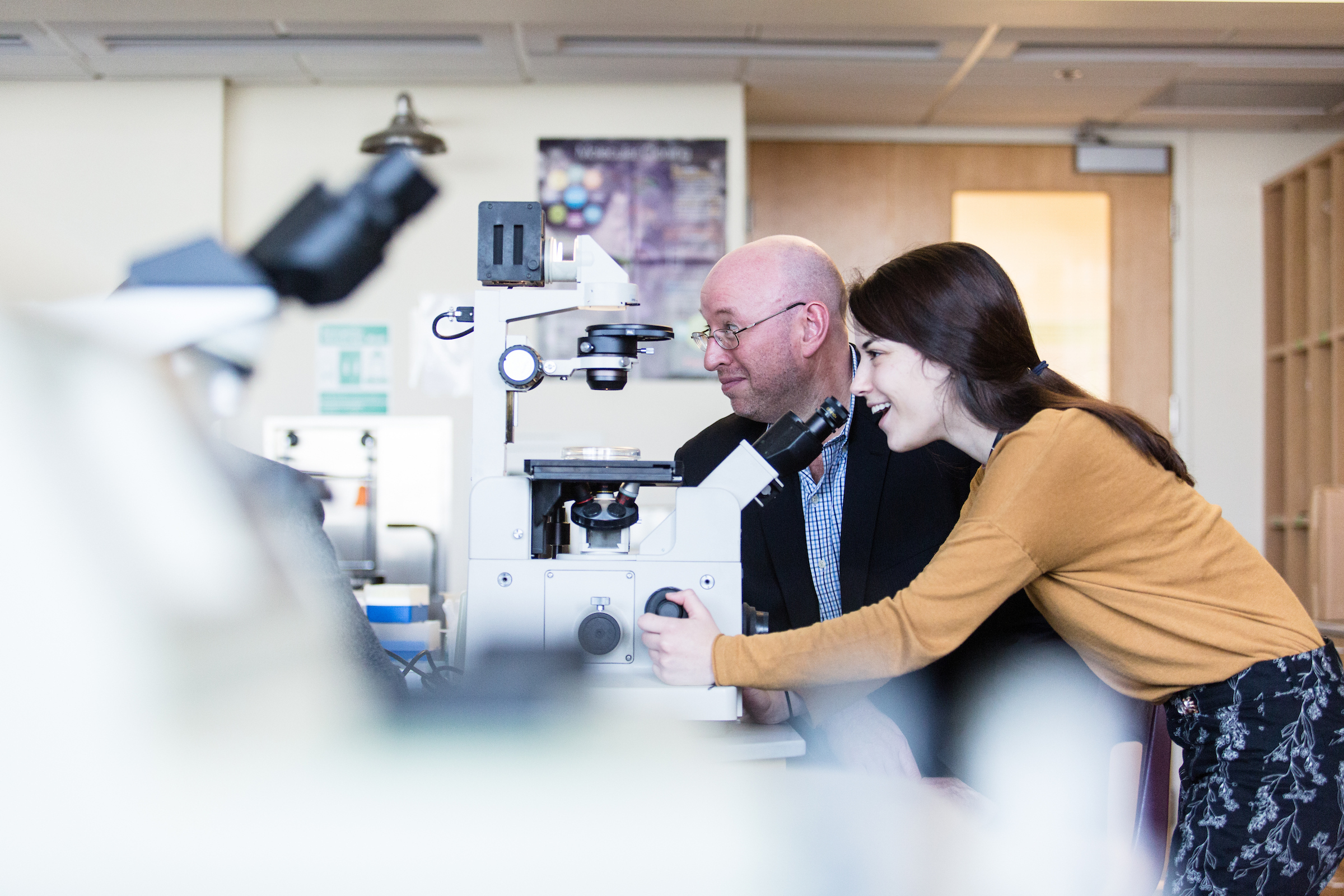
University of North Carolina Asheville Professor of Biology Ted Meigs, Ph.D., is the recipient of a $430,000 grant from the National Cancer Institute (NCI), the federal government's principal agency for cancer research and training. NCI is part of the National Institutes of Health (NIH).
The highly-competitive award – only 14% were funded from 2020-2025 – is the first from NCI to a UNC Asheville faculty member. Professor Meigs’ grant, Regulation of Tumorigenic G protein Signaling by Novel Post-translational Mechanisms, seeks to identify the underlying proteins that contribute to cancer, a disease that accounts for 10 million deaths worldwide each year, with the long-term goal to develop new medicines to eradicate cancerous tumors.
“It is imperative that we gain a better mechanistic understanding of the molecules that underlie this disease,” said Professor Meigs. “Our research, with the generous support of the National Cancer Institute, is part of an overall effort by the cancer research community worldwide that ultimately will save millions of lives. It’s exciting for our undergraduate Biology students to contribute to this critical work, an opportunity that is unique to UNC Asheville.”
About the research:
The human body contains trillions of cells, and each cell builds thousands of different proteins using our genes as blueprints. Each protein is a tiny molecular machine that controls a biochemical process in the cell such as metabolism, communication between cells, rate of cell reproduction (division), and other specialized functions. Many proteins, when mutated or overproduced in a cell, are implicated as contributors to the rapid cell division in cancer. Because cancer is responsible for roughly 10 million deaths worldwide each year, it is imperative that we better understand the function of protein molecules that underlie this disease.
Professor Meigs’s research group has studied G12 and G13 proteins for more than two decades. G12 and G13 are in nearly all human cells and are important in transmitting chemical signals from the outside to the inside of a cell to instruct cell functions. His laboratory’s students have uncovered multiple new mechanisms where unidentified proteins interact with G12 and/or G13 and impact their ability to drive cancerous growth. His current team of UNC Asheville undergraduate students are working to identify and characterize the proteins that chemically modify G12 and G13 and study the mechanisms of their cross-regulation (how the proteins control one another). This is an important step toward isolating small molecules (potential new pharmaceuticals) to manipulate the enzymatic modifications that govern G12 and G13, with the long-term goal of developing new medicines for tumors.
About UNC Asheville
Founded in 1927, UNC Asheville is a proud member of the University of North Carolina System. With award-winning faculty, small class sizes, and 60+ academic programs in the natural sciences, human sciences, humanities, arts, and social sciences, the University is recognized for its robust paid internship programs to prepare students to immediately enter the workforce. In the US News & World Report 2025 edition of Best Colleges, UNC Asheville is ranked No. #9 in Top Public Schools, and No. #7 in Princeton Review’s 2025 Top 50 Guide to Green Colleges. Known as the Bulldogs, UNC Asheville student-athletes compete in 16 NCAA Division I Teams in the Big South Conference. For more information, please visit: www.unca.edu.
Ready for What's Next?
At the University of North Carolina Asheville, you’ll experience an unparalleled liberal arts and sciences education. Take the next step and apply to become a Bulldog!